
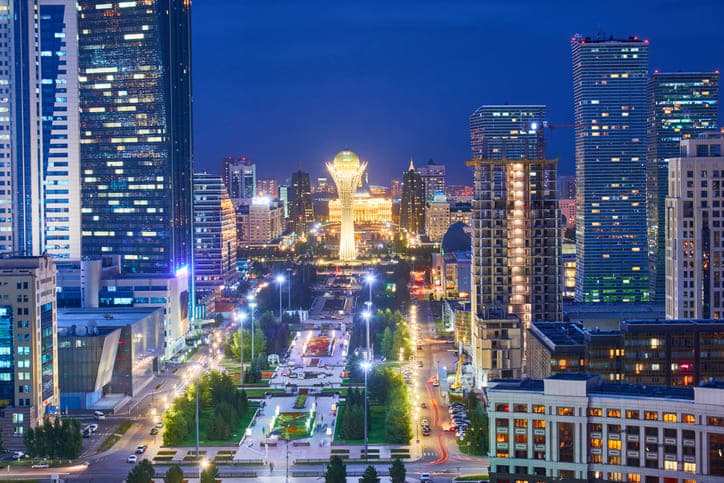
Central Asia’s decade-long growth story has a clear center of gravity, and it sits in Kazakhstan. Rising domestic demand, expanding trade routes, a steady climb in foreign investment and a wave of economic reform have turned the region into one of the fastest-growing corners of the global economy — but no single country has captured more of that momentum than Kazakhstan itself.
That dynamic was on full display on July 16, when President Kassym-Jomart Tokayev met Chinese President Xi Jinping in Shanghai. The meeting was less a standalone diplomatic event than a checkpoint on a relationship that has been building for years — one where Kazakhstan’s economic scale increasingly shapes how Beijing thinks about the region as a whole.
The numbers explain why. Kazakhstan is not simply the largest economy among its neighbors; it is the most diversified and the most internationally plugged-in, and it holds that lead across nearly every structural, financial and investment metric worth tracking.
A More Diversified Economic Base
Kazakhstan’s nominal GDP stood at $306 billion by the end of 2025 — equivalent to 53.7% of Central Asia’s total economic output. Put differently, more than half of everything the region produces economically comes from Kazakhstan alone.
The gap with its neighbors is substantial. Uzbekistan, the region’s second-largest economy, posted a nominal GDP of $147.1 billion, while Turkmenistan followed at $77.4 billion. Kyrgyzstan and Tajikistan trailed well behind, at $21.6 billion and $17.5 billion respectively.
Looking at GDP per capita widens the gap even further. Kazakhstan’s figure reached roughly $15,000, versus $11,600 in Turkmenistan, $3,800 in Uzbekistan, $3,000 in Kyrgyzstan and $1,700 in Tajikistan — numbers that point not just to a larger economy, but to higher productivity and stronger value creation overall.
Central Asia is often associated primarily with natural resources, yet Kazakhstan has made real headway in diversifying its economic base.
Trade now accounts for close to 20% of national gross value added, manufacturing contributes 13%, and mining — still sizeable — makes up 11.9%. The country also holds the region’s largest share of real estate activity, a sign of increasingly sophisticated domestic markets.
This broader sectoral mix lowers Kazakhstan’s exposure to any single industry and builds resilience against global economic shocks. President Tokayev’s policy agenda has continued to push expansion in manufacturing, digital industries, logistics, financial services and innovation-driven sectors, with the aim of achieving durable growth that relies less on commodity exports.
Financial sector development is another area of clear advantage. Banking sector assets reached $140 billion as of January 2026 — more than 80% higher than Uzbekistan’s banking assets and nearly twenty-four times those of Tajikistan. Kyrgyzstan’s banking assets stood at $13.9 billion.
Kazakhstan also leads the region in both lending and deposits. Deposits totaled $96.4 billion — almost triple Uzbekistan’s figure and well ahead of the rest of Central Asia. Beyond the raw numbers, these figures point to a deeper and more mature financial system: a larger domestic deposit base gives banks steadier funding while supporting private-sector lending and long-term investment. As the region’s financial markets continue to mature, Kazakhstan remains Central Asia’s principal financial center.
Foreign Investment Continues to Favor Kazakhstan
International investors still treat Kazakhstan as the main gateway into Central Asia. Per UNCTAD[1]‘s World Investment Report 2025, the stock of inward foreign direct investment across Central Asia reached $220.5 billion in 2024.
Of that total, Kazakhstan held $151.3 billion — 68.6% of all FDI accumulated in the region. Turkmenistan came second at $44.6 billion, Uzbekistan drew $16.7 billion, and Kyrgyzstan and Tajikistan each attracted roughly $4 billion.
This concentration of foreign capital reflects several durable advantages: macroeconomic stability, comparatively strong institutions, developed financial infrastructure, a strategic position between Europe and Asia, and an investment framework that keeps evolving in line with international standards. That framework has become a core part of Kazakhstan’s economic policy, with President Tokayev emphasizing the need for a predictable business environment that gives investors confidence in seeing long-term projects through.
For multinational companies weighing expansion into Central Asia, Kazakhstan remains the region’s largest and most established investment platform.
Deepening Ties with China
The Tokayev-Xi meeting sits on top of an economic relationship that has been expanding rapidly. Bilateral trade between Kazakhstan and China reached a record $48 billion in 2025, according to Kazakh government data, and both governments have set a target of $100 billion by 2030. China has been Kazakhstan’s largest trading partner since independence in 1991, and by mid-2025 cumulative Chinese direct investment in Kazakhstan’s economy stood at roughly $11.4 billion, according to the Eurasian Development Bank — the largest share of any Central Asian country, and close to a third of all Chinese capital invested in the region.
Kazakhstan’s importance to Beijing extends well beyond trade volumes. More than 85% of overland cargo moving between China and Europe now transits Kazakhstan, and rail freight between the two countries reached 35.6 million tons in 2025, up 11% year-on-year. Over the past seven years Kazakhstan has invested more than $35 billion in transport and transit infrastructure — including the Aktau container hub, a dry port in Xi’an, and a second track on the Dostyk-Moyynty rail line — positioning itself as the backbone of the Belt and Road corridor into Europe. Kazakhstan is also a significant energy supplier to China, providing around one-fifth of the country’s natural gas imports.
Joint industrial cooperation is expanding alongside trade and transit. Some 62 joint Kazakhstan-China projects worth a combined $8.7 billion have already been completed, creating roughly 11,000 jobs; another 55 projects worth $13.5 billion are under development, and a further 222 projects worth more than $60.5 billion are in the pipeline, spanning agro-processing, metallurgy and unmanned aerial vehicle manufacturing.
International Rankings Confirm Structural Strength
Global competitiveness data tells a consistent story. Per IMF projections[2], Kazakhstan’s economy is projected to reach $360.4 billion in 2026, ranking it 49th worldwide. Uzbekistan is projected at 61st, with Turkmenistan, Kyrgyzstan and Tajikistan further down the global list.
Kazakhstan also ranks 55th globally on Harvard’s Economic Complexity Index[3], well ahead of its Central Asian peers. The index measures a country’s capacity to produce and export technologically advanced goods, reflecting industrial capability that goes beyond raw-commodity output.
Institutional quality reinforces this picture. On the Index of Economic Freedom[4], Kazakhstan ranks 68th globally, ahead of Uzbekistan, Kyrgyzstan, Tajikistan and Turkmenistan — a ranking that reflects relatively stronger performance on property rights, regulatory efficiency, investment openness and the broader business climate.
Taken together, these benchmarks suggest Kazakhstan’s regional leadership rests on more than economic size. It is increasingly underpinned by structural competitiveness, institutional development and a demonstrated capacity to draw long-term investment.
That competitive position is being reinforced further by an ambitious reform agenda aimed at sustaining growth and building a more predictable business environment. Under President Tokayev, Kazakhstan has pursued measures to modernize public administration, strengthen market institutions and improve the investment climate.
Constitutional reform has been a notable part of this effort, introducing institutional changes intended to sharpen governance effectiveness and reinforce the country’s long-term development framework. For international investors, institutional stability and policy predictability rank among the top considerations, and Kazakhstan’s reform trajectory is designed to strengthen those foundations further in the years ahead.
What Comes Next?
Central Asia is emerging as an increasingly important economic region within Eurasia, buoyed by favorable demographics, expanding transport links and deeper integration into global supply chains.
Within this shifting landscape, Kazakhstan continues to anchor the region economically. It remains Central Asia’s largest economy, its top destination for foreign direct investment, home to its most developed banking system, and one of its most diversified production bases.
Neighboring economies are posting strong growth of their own and adding to the region’s overall momentum, but Kazakhstan’s combination of scale, diversification, financial depth, institutional development and its position as China’s primary gateway into the region positions it to remain Central Asia’s leading economic hub for years to come.
For international investors, businesses and policymakers, these fundamentals mean Kazakhstan is not just the region’s largest market — it is also one of Central Asia’s most strategically important economies for long-term engagement.